
1. Introduction
In the realm of precision motion control and heavy-duty transmission, the choice of coupling dictates the system's resonant frequency, positioning accuracy, and fatigue life. Utilizing the COUP-LINK LK8 (Star Type) and LK5 (Membrane Type) series as benchmarks, this paper explores the mechanical divergence between elastomeric damping and metallic flexure architectures.
2. Structural Mechanics and Torsional Behavior
The fundamental difference between these two series lies in the medium of torque transmission:
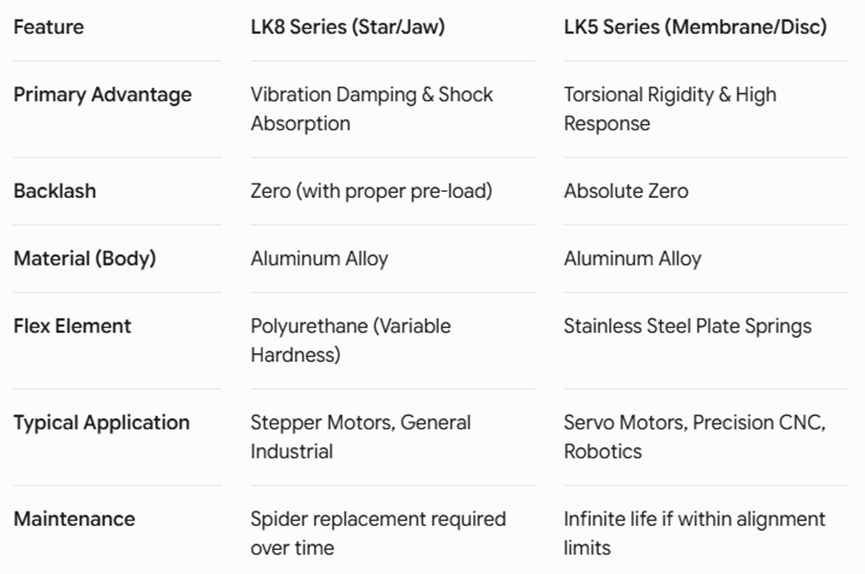
The LK8 Series (Star/Curved Jaw): This coupling utilizes a compression-based mechanism. A polyurethane sleeve (spider) is pressed between two aluminum alloy hubs. The "Curved Jaw" design ensures that the elastomeric spider is loaded in compression, which allows for higher torque density in a compact footprint. By offering four different hardness levels (from 80 Shore A to 64 Shore D), the LK8 allows engineers to tune the torsional stiffness and damping coefficient of the drive string.
The LK5 Series (Membrane/Disc): This coupling relies on the tensile and shear strength of a Stainless Steel Integrated Diaphragm Set. Unlike the LK8, which has a non-linear stiffness curve due to the elastomer, the LK5 provides a high, linear torsional spring rate. The "Double Plate Springs" architecture allows for significantly higher kinematic fidelity, as the metallic interface eliminates the "wind-up" associated with plastic deformation.
3. Kinematic Fidelity: Backlash and Response
For clients resolving selection challenges in servo-driven environments, the concept of "Zero Backlash" is paramount.
Precision and Response: The LK5 is engineered specifically for Zero Backlash operation. Because it uses stainless steel plates, there is no hysteresis during direction reversals. This makes it the superior choice for high-speed indexing and closed-loop servo systems where the motor's encoder must perfectly match the load position.
Vibration Attenuation: The LK8, while "Zero Backlash" when initially pre-tensioned, is primarily valued for its vibration absorption capabilities. In systems where the prime mover (such as an internal combustion engine or a stepper motor with high torque ripple) induces significant harmonics, the LK8's polyurethane insert acts as a low-pass filter, protecting sensitive downstream components from peak torque transients.
4. Misalignment Compensation and Environmental Resilience
Both the LK8 and LK5 series utilize a Clamp Type hub for a secure, non-destructive mechanical interference fit, but they handle shaft deviations differently:
Degrees of Freedom: The LK5 "Double Plate Springs" design is particularly adept at absorbing angular and shaft end-play through the elastic bending of the diaphragms. However, it is less tolerant of large radial misalignments compared to the LK8.
Environmental Factors: The LK8 features resistance to oil and electrical insulation, making it ideal for industrial environments where hydraulic fluids or electrical isolation between the motor and the gearbox are concerns. The LK5, being predominantly metal with stainless steel flex elements, offers superior thermal stability and performance in high-temperature applications where elastomers might degrade.
5. Selection Matrix for Engineering Applications
6. Conclusion
The selection between the COUP-LINK LK8 and LK5 series depends on whether the system's priority is protection or precision. If the application involves high shock loads and requires vibration isolation, the LK8 Star Coupling is the optimal solution. Conversely, if the application requires high-frequency response, absolute positioning accuracy, and zero-backlash fidelity—typical of high-end CNC and robotic armatures—the LK5 Membrane Coupling is the technically superior choice.
