

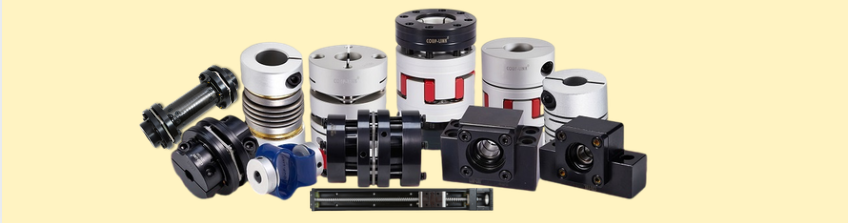
Abstract
As a critical connecting component in mechanical transmission systems, the scientific selection of couplings directly affects equipment accuracy, service life, and reliability. Based on the COUP-LINK product portfolio, this paper systematically presents coupling selection principles, parameter calculation methods, and engineering considerations for applications such as servo motors, stepper motors, spindles, and encoders. Topics covered include torque and stiffness matching, misalignment compensation capability assessment, material selection (aluminum alloy/stainless steel), connection methods (clamping type/set screw type), installation alignment requirements, and maintenance guidelines, supported by typical industry case studies. This document provides mechanical design engineers with a comprehensive and professional engineering guide for coupling selection.
In the niche field of coupling selection, COUP-LINK leverages nearly three decades of technical expertise, a full-series product matrix, and precision manufacturing capabilities to deliver optimal matching solutions for global customers.
Keywords: COUP-LINK; Coupling Selection; Servo Drive; Torque Matching; Misalignment Compensation; Zero Backlash
2. Basic Principles of Coupling Selection
2.1 Torque Capacity Verification
The primary basis for selection is torque parameters. Design engineers must calculate both rated torque and peak torque:
Rated Torque: The maximum torque a coupling can continuously transmit under normal operating conditions. Selection requires that the coupling’s rated torque ≥ motor rated torque × service factor. COUP-LINK product manuals clearly specify rated torque for each model and provide recommended service factors for different load types (smooth load: 1.0–1.5; moderate impact: 1.5–2.0; heavy impact: 2.0–3.0).
Peak Torque: The maximum torque occurring during starting, braking, or impact conditions. The coupling’s maximum torque (typically 1.5–3 times rated torque) must exceed the actual peak torque. COUP-LINK recommends reserving at least 20% torque margin during selection to accommodate unforeseen overload conditions.
2.2 Shaft Diameter and Installation Space Matching
The coupling’s bore diameter range must accommodate both motor shaft and load shaft diameters. COUP-LINK offers bore sizes from 3 mm up to over 50 mm, with non-standard customization available. Additionally, the coupling’s maximum outer diameter and overall length must fit the available axial and radial installation space. For compact equipment, COUP-LINK short-type couplings effectively save space.
2.3 Speed and Critical Speed
For high-speed applications exceeding 5,000 rpm, attention must be paid to the coupling’s maximum allowable speed and critical speed. COUP-LINK clamping-type bellows couplings and diaphragm couplings are dynamically balanced (balance grade G2.5) and can be reliably used in high-speed spindles, centrifuges, and similar applications. Selection requires ensuring that the operating speed is below 80% of the coupling’s first-order critical speed.
2.4 Misalignment Compensation Capability
In practice, radial, angular, and axial misalignments are inevitable. Different coupling types offer significantly different compensation capabilities. Selection should be based on expected installation alignment accuracy:
High-precision alignment (radial misalignment ≤0.02 mm): COUP-LINK LK13 rigid couplings may be used, offering zero backlash and ultra-high stiffness suitable for precision measuring instruments.
General alignment (radial misalignment 0.05–0.1 mm): COUP-LINK LK6/LK7 bellows couplings or LK10 diaphragm couplings are suitable, providing good compensation capability.
Larger misalignment (radial misalignment 0.1–0.2 mm): COUP-LINK LK8 jaw couplings are recommended. Their elastomer can compensate for radial misalignment up to 0.2 mm, angular misalignment up to 1°, and axial misalignment up to ±1 mm, making them ideal for packaging, printing, and other applications where installation errors are expected.
2.5 Stiffness Characteristics
Torsional stiffness affects the dynamic response and positioning accuracy of the transmission system. COUP-LINK bellows couplings and diaphragm couplings offer high torsional stiffness, suitable for high-precision servo positioning. Jaw couplings, with their elastomer, provide certain buffering and vibration isolation, suitable for applications with impact loads.
3. Main COUP-LINK Coupling Types and Selection
3.1 Bellows Couplings (LK6/LK7 Series)
Technical Features: Zero backlash, high torsional stiffness, low moment of inertia, good multi-directional misalignment compensation capability.
Applications: Servo motors, stepper motors, encoder connections, precision positioning stages, semiconductor equipment.
Selection:
Prioritize torque and stiffness requirements when selecting specifications.
For high-speed applications, the clamping type structure must be selected to ensure dynamic balance performance.
COUP-LINK offers both aluminum alloy and stainless steel materials, as well as standard and long-span models.
Typical Models: COUP-LINK LK6 (standard type), COUP-LINK LK7 (parallel elastic type)
3.2 Diaphragm Couplings (LK10 Series)
Technical Features: High torque density, maintenance-free, high-temperature resistance (-80~300°C), excellent compensation capability, zero backlash.
Applications: High-power servo drives, spindle drives, fans, pumps, compressors.
Selection:
Focus on verifying peak torque and fatigue life.
A greater number of diaphragm groups provides stronger compensation capability.
COUP-LINK uses stainless steel diaphragms with outstanding fatigue resistance.
Typical Model: COUP-LINK LK10 (multi-diaphragm design)
3.3 Jaw Couplings (LK8 Series)
Technical Features: Polyurethane elastomer for vibration absorption and isolation, multi-directional misalignment compensation, zero backlash, good economy, oil-resistant and insulating.
Applications: Packaging machinery, conveying equipment, general automation, injection molding machines, printing machinery.
Selection:
Select elastomer hardness based on torque and damping requirements: COUP-LINK offers 80A (flexible), 92A (general purpose), and 98A (high rigidity).
Clamping type structure is superior to set screw type and suitable for frequent start-stop applications.
Aluminum alloy body provides high strength and light weight.
Typical Model: COUP-LINK LK8 (clamping-type jaw coupling)
3.4 Rigid Couplings (LK13 Series)
Technical Features: Zero backlash, ultra-high torsional stiffness, simple construction, no misalignment compensation capability, high concentricity.
Applications: High-precision alignment applications, measuring instruments, light-load connections, encoder fixing.
Selection:
Installation alignment accuracy must be extremely high (radial ≤0.02 mm, angular ≤0.05°).
COUP-LINK offers both aluminum alloy (lightweight) and stainless steel (corrosion-resistant) materials.
Bore tolerances available in H7, H8, G7, and F8 to accommodate different fit requirements.
Typical Model: COUP-LINK LK13-C (clamping-type rigid coupling)
3.5 Encoder Couplings (LK12 Series)
Technical Features: Zero backlash, low moment of inertia, electrical isolation (fiberglass intermediate element), non-magnetic.
Applications: Connecting encoders to motor shafts, precision feedback systems, medical equipment.
Selection:
Confirm insulation voltage withstand requirements (COUP-LINK LK12 withstands up to 1500 V).
Extremely low moment of inertia does not affect encoder dynamic response.
Composite structure of steel hubs and fiberglass intermediate element balances strength and insulation.
Typical Model: COUP-LINK LK12 (fiberglass insulated encoder coupling)
4. Material Selection: Aluminum Alloy vs. Stainless Steel
COUP-LINK offers both aluminum alloy and stainless steel materials for most coupling series. Selection recommendations are as follows:
| Application | Recommended Material | Rationale | COUP-LINK Representative Model |
| High speed, high dynamic response | Aluminum alloy | Low density (2.7 g/cm³), low moment of inertia, good acceleration | LK6, LK7 |
| Corrosive environments (humidity, salt spray, chemicals) | Stainless steel | Excellent corrosion resistance, protective passivation layer | LK6, LK13 |
| Food/medical equipment | Stainless steel | Meets hygiene standards, easy to clean and sterilize | LK8, LK12 |
| Cost-sensitive applications | Aluminum alloy | Lower material and machining cost, good economy | LK8 |
| High strength / heavy load / impact | Stainless steel | High elastic modulus (193 GPa), high strength, wear-resistant | LK10 |
COUP-LINK aluminum alloy couplings are anodized for high surface hardness and corrosion resistance. Stainless steel couplings are passivated to further enhance corrosion resistance.
5. Connection Methods: Clamping Type vs. Set Screw Type
COUP-LINK products offer two mainstream connection methods. Selection should consider torque, speed, accuracy requirements, and maintenance convenience.
5.1 Clamping Type Connection
Principle: Axial bolts apply radial clamping force to the hub, causing uniform contraction of the hub bore and achieving keyless friction connection with the shaft.
Advantages:
No shaft surface damage, no stress concentration from keyways.
High concentricity (≤0.02 mm), self-centering.
Multiple assembly/disassembly cycles with good repeatable accuracy.
Suitable for high-speed rotation (excellent dynamic balance).
High torque capacity.
Disadvantages:
Requires torque wrench and sequential staged tightening.
Slightly longer axial dimension.
Recommended Applications: Servo systems, high-speed spindles, precision positioning, frequent start-stop. COUP-LINK clamping-type couplings (e.g., LK6-C, LK8-C, LK13-C) are the first choice for precision transmission.
5.2 Set Screw Type (Grub Screw) Connection
Principle: Radially positioned set screws directly clamp the shaft surface, often supplemented by keyways or D-shaped flats to prevent relative rotation.
Advantages:
Simple structure, quick installation (no torque wrench required).
Lower cost.
Shorter axial dimension, space-saving.
Disadvantages:
Set screws leave indentations on the shaft surface, damaging the shaft.
Poor repeatable installation accuracy.
Poor dynamic balance, unsuitable for high speeds.
Prone to loosening under vibration.
Recommended Applications: Light-load, low-speed, cost-sensitive, simple automation equipment where frequent disassembly is not required. COUP-LINK set screw type couplings (e.g., LK6-S) may serve as an economical alternative.
Selection Recommendation: For the vast majority of precision transmission applications, COUP-LINK strongly recommends the clamping type connection due to its superior long-term reliability and accuracy retention.
6. Installation and Maintenance
6.1 Pre-installation Preparation
Clean the shaft end and coupling bore, removing oil, rust preventatives, and contaminants. COUP-LINK recommends using anhydrous alcohol or acetone.
Verify that shaft diameter tolerance is within the recommended range (h6 or h7), with surface roughness Ra ≤1.6 μm.
Prepare a calibrated torque wrench and appropriately sized hex keys.
6.2 Installation Procedure (using COUP-LINK clamping type as example)
Gently push the coupling onto the motor shaft and load shaft, ensuring insertion depth meets design requirements on both ends.
Use a dial indicator or laser alignment tool to adjust shaft concentricity, bringing radial and angular misalignments within allowable ranges.
Tighten clamping bolts in a diagonal sequence in 2–3 stages, progressively increasing torque to the final value specified in the COUP-LINK product manual.
After tightening, recheck alignment accuracy to confirm no changes.
Run no-load for 30 minutes to check vibration and temperature rise; only then put into production after confirming normal operation.
6.3 Alignment Accuracy Requirements
COUP-LINK bellows/diaphragm/jaw couplings: radial misalignment ≤0.1 mm, angular misalignment ≤0.3°.
COUP-LINK rigid couplings: radial misalignment ≤0.02 mm, angular misalignment ≤0.05°.
Good alignment can extend coupling and motor bearing life by more than three times.
6.4 Maintenance and Inspection
Recheck clamping bolt torque 24 hours after initial operation (COUP-LINK recommendation).
For jaw couplings, inspect the elastomer every 6 months for aging or cracking.
Periodically listen for abnormal operating sounds; shut down immediately if unusual vibration is detected.
In corrosive environments, stainless steel material can extend maintenance intervals.
7. Typical Case Study: COUP-LINK LK8 Reduces Downtime and Improves Efficiency in Packaging Machinery
Customer: A packaging machinery manufacturer (high-speed horizontal packaging machine)
Problem: The servo drive system suffered from shaft misalignment and excessive vibration. Servo motors failed approximately every three months, resulting in about 8 hours of downtime per month, high maintenance costs, and low production efficiency.
Selected Solution: COUP-LINK LK8 clamping-type jaw coupling (aluminum alloy body, 92A hardness polyurethane elastomer, 24×24 mm bore) replaced the original standard flexible coupling.
Implementation Results (6-month tracking data):
Downtime reduced by 40% (from 8 hours per month to 0.5 hours per month)
Servo motor service life extended by 25% (from 1 year to over 1.25 years)
Peak vibration reduced by 68% (from 2.5g to 0.8g)
Cutting knife positioning error reduced from ±0.15 mm to ±0.05 mm
Overall equipment effectiveness (OEE) increased by 12%
Conclusion: Correct coupling selection and COUP-LINK product performance have a significant impact on equipment reliability.
8. Conclusion and Outlook
Coupling selection is a systematic engineering task involving multiple factors: torque, speed, shaft diameter, space, misalignment, stiffness, material, connection method, environmental conditions, and cost. Based on the COUP-LINK product portfolio, this paper systematically elaborates the technical characteristics and selection of various coupling types, and provides an engineering-oriented selection process along with installation and maintenance guidelines.
In the niche field of coupling selection, COUP-LINK leverages nearly three decades of technical expertise, over 30 product series, dual material options (aluminum alloy/stainless steel), multiple connection methods (clamping/set screw), and full capability from standard products to non-standard customization, continuously delivering high-precision, high-reliability transmission connection solutions to global customers.
In the future, with the development of smart manufacturing and the Industrial Internet of Things, couplings will evolve towards intelligence, condition monitoring, and predictive maintenance. COUP-LINK has already begun in this area and will launch smart couplings with integrated sensors and wireless communication to further enhance the digitalization level of transmission systems.
