

1. Introduction
1.1 Research Background
Precision transmission systems (e.g., servo drives, semiconductor equipment, industrial robots) have growing demand for couplings with "high rigidity, zero backlash, and compactness." Traditional disc couplings rely on independent disc sets, resulting in larger axial dimensions; rubber slit couplings suffer from insufficient stiffness and easy aging. Slotted metal slit couplings, centered on a "one-piece integrated metal slotted structure," combine compactness and high rigidity, emerging as a critical component in high-end precision transmission.
1.2 Research Significance
Academically, this work supplements the structure-performance coupling theory of one-piece integrated elastic couplings and improves the stress distribution and fatigue life models of slotted structures. From an engineering perspective, it provides theoretical support for coupling selection, localization substitution, and customized design in precision equipment (e.g., lithium battery lamination machines, lithography machine transmission units), addressing the issue of high-end market monopoly by foreign brands.
2. Basic Theory of Slotted Metal Slit Couplings
2.1 Definition and Classification
2.1.1 Definition
A slotted metal slit coupling is a compact flexible coupling that uses a one-piece integrated metal cylinder as the substrate, forms elastic units by machining axial/circumferential slots, and compensates for relative shaft displacement and transmits torque via elastic deformation of the slots. Its core features include "zero backlash, high torsional stiffness, and one-piece non-modular structure."
2.1.2 Classification
Classified by slot layout:
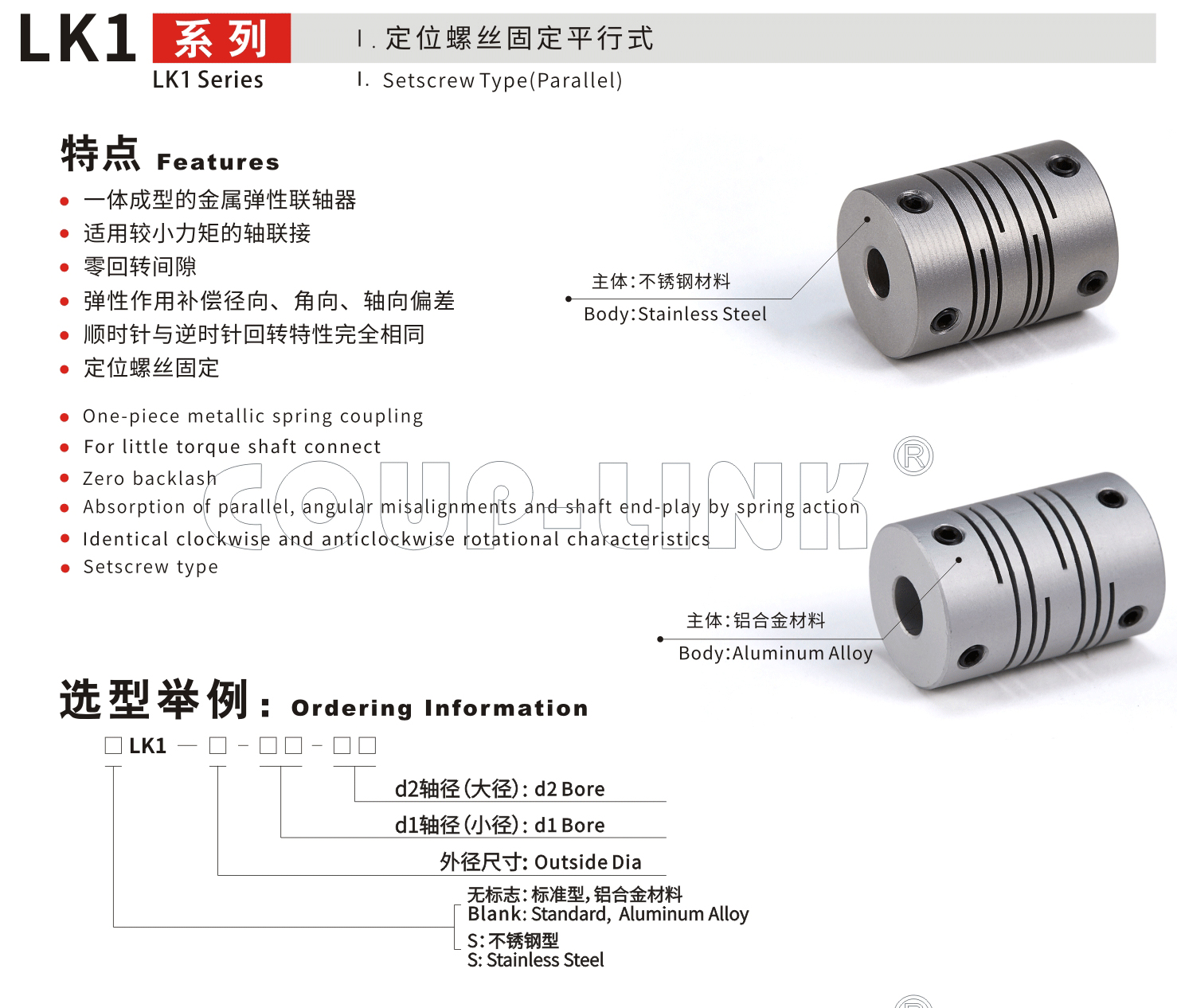
Parallel-slot type (the Coup-Link product in the figure): Slots are distributed axially in parallel with staggered openings, suitable for medium-low load precision servo scenarios;
Helical-slot type: Slots are helically distributed, offering more uniform torsional stiffness, suitable for high-speed, small-offset high-speed transmission scenarios.
2.2 Structural Composition and Core Design Parameters
2.2.1 Structural Composition
Manufactured via one-piece CNC machining of aluminum alloy (6061-T6) or stainless steel (304), the core structure includes:
Shaft bore: Fixed to the driving/driven shaft via key connection or expansion sleeve;
Slot unit: Multiple sets of slots (5 parallel slots in the figure) machined on the substrate, serving as the core area for elastic deformation;
Substrate: Connects the shaft bore and slot unit to ensure structural integrity.
2.2.2 Core Design Parameters
Typical design parameters (taking Coup-Link MCS series as an example):
Slot width: 0.5~1.5 mm, depth 70%~85% of the substrate radius;
Shaft bore tolerance: Class H7, ensuring coaxiality of shaft connections;
Length-to-diameter ratio: 1.2~2.0, enabling compact design.
2.3 Working Principle
Functionality is achieved via multi-mode elastic deformation of the slot unit:
Torque transmission: Under torque, the slot unit undergoes shear deformation, and the elastic restoring force of the metal substrate ensures slip-free torque transmission, with torsional stiffness reaching 10~50 N·m/° (for aluminum alloy);
Displacement compensation:
Radial offset: Bending deformation of the slot unit, typical compensation range ±0.1~0.3 mm;
Angular offset: Torsional deformation of the slot unit, typical compensation range ±0.5~1.5°;
Axial runout: Tensile/compressive deformation of the slot unit, typical compensation range ±0.2~0.5 mm.
3. Core Performance Characterization and Analysis
3.1 Mechanical Performance
Torsional stiffness: The torsional stiffness of the one-piece structure is 20%~35% higher than that of split-type disc couplings (for the same size). Finite element simulation shows: reducing slot width by 10% increases torsional stiffness by ~12%, but raises the stress concentration factor by 8%;
Fatigue life: The slot root is a stress concentration zone (stress concentration factor 3.2~4.5). Fillet transition design can increase the ultimate torque corresponding to 10⁷-cycle fatigue life by 15%;
Load capacity: Aluminum alloy models have a rated torque of 0.5~50 N·m, while stainless steel models reach 100~200 N·m, suitable for micro-servo to small-medium transmission systems.
3.2 Transmission Accuracy Characteristics
Zero backlash: The one-piece structure has no assembly clearance, with transmission error < 0.01°, suitable for scenarios requiring precise angular displacement transmission (e.g., encoders, precision positioning platforms);
Low moment of inertia: The moment of inertia of aluminum alloy models is only 60%~70% that of disc couplings with the same torque rating, improving the response speed of servo systems (step response time shortened by 10%~15%).
3.3 Environmental Adaptability
Operating temperature range: -40~120°C (aluminum alloy), -80~300°C (stainless steel);
Media resistance: No rubber components, oil-resistant and chemically corrosion-resistant, suitable for chemical precision pumps and lithium battery electrolyte environments.
4. Research Status and Industrial Pattern
4.1 Global Technological Progress
Structural optimization: Foreign brands (e.g., Germany’s R+W, USA’s Lovejoy) use topology optimization to design slot layouts, reducing the stress concentration factor to below 2.8 while increasing displacement compensation capacity by 15%;
Material innovation: Titanium alloy + additive manufacturing is used to realize complex slot structures, further reducing the moment of inertia by 25%, suitable for aerospace lightweight transmission.
5. Typical Application Scenarios
Servo drive systems: Connect servo motors and ball screws (e.g., positioning shafts of lithium battery lamination machines), ensuring positioning accuracy of ±0.02 mm;
Semiconductor equipment: Transmission units of lithography machine worktables, meeting requirements for high rigidity (torsional stiffness > 40 N·m/°) and low moment of inertia;
Industrial robots: Joint transmission of collaborative robots, with one-piece compact structure adapting to narrow installation spaces.
6. Future Research Directions
Structure-performance collaborative optimization: Adopt bionic slot structures (e.g., honeycomb slots) to reduce stress concentration while improving compensation capacity;
New materials and manufacturing processes: Develop carbon fiber-reinforced aluminum alloy and ceramic matrix composites, combined with additive manufacturing to realize integrated forming of complex slots;
Intelligent integration: Embed micro strain sensors to monitor torque and deformation, and build digital twin models to enable predictive maintenance.
7. Conclusions
Slotted metal slit couplings, with features of "one-piece integration, high rigidity, and zero backlash," are core components of precision transmission systems. Current research needs to address bottlenecks such as stress concentration and large displacement compensation. In the future, through structural optimization, material innovation, and intelligent upgrading, full localization in high-end fields (e.g., semiconductors, robots) is expected, providing support for improving the performance of transmission systems in China’s high-end equipment.
