

1. Basic Theory of Locking Assemblies Couplings
2.1 Definition and Classification
2.1.1 Definition
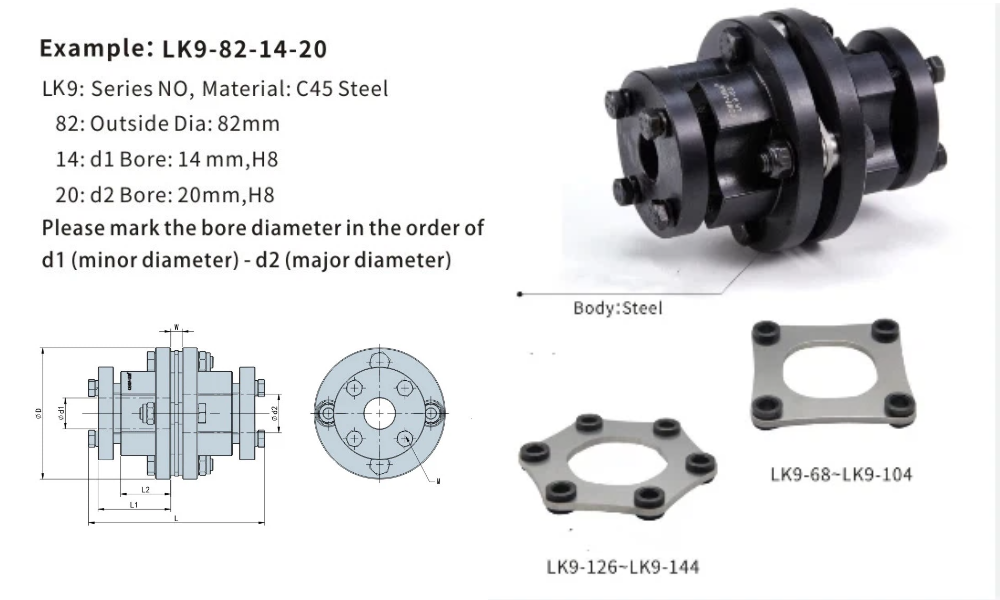
According to the national standard JB/T 9147-1999 and industry consensus, a diaphragm coupling is a high-performance flexible coupling that uses a set of thin metal diaphragms as the elastic element, connects two half-couplings through bolts, and compensates for relative displacement between two shafts and transmits torque by means of elastic deformation of the diaphragms. Its core characteristics are zero rotational backlash and no need for lubrication, making it suitable for multiple industrial scenarios.
2.1.2 Classification
It can be divided into three types according to structural forms:
• Single disc set type:Simple structure, suitable for light-load and low-offset working conditions (such as small servo motor transmission) with limited displacement compensation capacity.
• Double disc set type:Equipped with two sets of diaphragms (connected by a rigid element in the middle), it has stronger angular/axial compensation capacity and is suitable for scenarios with large shafting deviations such as large turbomachinery.
• Multi-stage series type:Multiple diaphragm sets connected in series, designed for ultra-high-speed/extreme misalignment working conditions (such as the main shaft connection of million-kilowatt nuclear power steam turbines).
2.2 Structural Composition and Core Components
2.2.1 Structural Disassembly
The core components include a diaphragm set (elastic core), half-couplings (connecting shafts and diaphragm sets), and bolts (fastening components); the special structure with an intermediate shaft can realize disassembly and assembly without moving equipment, improving maintenance efficiency.
2.2.2 Characteristics of Core Components
• Diaphragm set: Made of 0.3-0.5mm thick 304/316 stainless steel sheets, the laminated design improves fatigue life (over 1 million cycles internationally, and 3-4 years of continuous operation domestically).
• Half-coupling: Made of 45# steel or alloy structural steel, precision machining ensures coaxiality and reduces vibration and noise.
• Bolts: High-end products adopt high-strength alloy bolts with a yield strength exceeding 1000MPa, and surface anti-corrosion treatment is applied to adapt to harsh environments.
2.3 Working Principle
2.3.1 Torque Transmission Mechanism
The torque transmission path is: driving shaft → half-coupling → diaphragm set → driven shaft half-coupling. The diaphragm set produces micro elastic deformation (no plastic deformation) under torque, realizing slip-free transmission with a power transmission efficiency of 99.86%.
2.3.2 Displacement Compensation Mechanism
Three types of displacement compensation are realized based on elastic deformation:
• Axial displacement: The diaphragm absorbs axial deviation through tensile/compressive deformation.
• Radial displacement: The diaphragm adapts to radial deviation through bending deformation.
• Angular displacement: The diaphragm compensates for angular deviation (such as ±1.5° installation error) through torsional deformation, avoiding additional radial force on the bearing.
3. Analysis of Core Characteristics of Locking Assemblies Couplings
3.1 Transmission Accuracy Characteristics
The core advantages are "zero rotational backlash" and "high synchronization". The rigid connection between the diaphragm set and the half-coupling ensures no relative sliding, guaranteeing consistent rotational speeds of the two shafts, which is suitable for high-precision scenarios such as lithium battery lamination machines and precision machine tools. Compared with gear couplings, there is no precision attenuation caused by tooth surface wear, and the long-term stability of transmission accuracy is improved by more than 20%.
3.2 Environmental and Working Condition Adaptability
3.2.1 Extreme Environment Resistance
The temperature adaptation range is -80℃ to 300℃, suitable for high-temperature furnace fans, low-temperature cold chain equipment and other scenarios; it is resistant to acid, alkali and oil pollution, adapting to corrosive working conditions such as chemical pumps and petrochemical compressors; the lubrication-free design avoids oil pollution, meeting the cleanliness requirements of food/pharmaceutical equipment.
3.2.2 Dynamic Load Adaptability
The elastic deformation of the diaphragm can absorb vibration and impact, reducing noise by 15-20dB compared with rigid couplings, and is suitable for dynamic load scenarios such as mining machinery and marine transmission; the impact load tolerance is 10%-15% higher than that of ordinary couplings, ensuring stable operation of the shafting.
3.3 Maintenance and Service Life Characteristics
It has the advantage of "maintenance-free", no need for lubrication, reducing 3-4 maintenance works per year and lowering downtime costs; the simple structure shortens the disassembly and assembly time by 50% compared with gear couplings. In terms of service life, international high-end products (such as German R+W) can operate continuously for more than 5 years, and domestic mainstream products can reach 3-4 years. The fatigue life is positively correlated with the diaphragm material and the number of laminations.
3.4 Mechanical Performance Characteristics
The torque transmission range is 0.5-10000N·m, suitable for micro servo motors to large turbomachines; high-end products have radial compensation of ±0.5mm, axial compensation of ±5mm, and angular compensation of ±1.5°. Compared with bellows couplings, it has a wider displacement compensation range and 20%-30% lower additional bearing load.
4. Typical Application Scenarios of Locking Assemblies Couplings
4.1 Wind Power Industry
4.1.1 Application Position and Requirements
Used to connect the wind turbine main shaft and generator, it needs to withstand alternating loads and salt spray corrosion of offshore wind power, meeting the requirements of lightweight (reducing nacelle load) and 20-year design life. The sales revenue of China's wind power diaphragm coupling market reached X yuan in 2024, and the CAGR is expected to be X% by 2031.
4.1.2 Technical Adaptation Case
Intelligent's wind power diaphragm coupling adopts multi-layer 316L stainless steel diaphragms, with axial compensation of ±4mm and radial compensation of ±0.3mm, suitable for 2.5-6MW offshore wind turbines. The fault shutdown rate is less than 0.5% per year, significantly better than the industry average.
4.2 Lithium Battery Equipment Industry
4.2.1 Core Application Scenarios
Servo drive of coating machines (connecting servo motors and coating rollers to ensure linear speed accuracy of ±0.1m/min and improve pole piece thickness uniformity), positioning transmission of lamination machines (connecting motors and ball screws with positioning accuracy of ±0.02mm), requiring zero backlash and high torque rigidity.
4.2.2 Product Selection Points
Priority is given to the double diaphragm structure (compensating for assembly errors); the diaphragm material is 304 stainless steel (resistant to electrolyte corrosion); the coupling inertia is controlled at 0.01-0.1kg·m² (adapting to the rapid response of the servo system).
4.3 Turbomachinery Industry
Applied to the main shaft connection of steam turbines and compressors, adapting to ultra-high-speed (3000-15000r/min) and high-temperature (200-300℃) working conditions. It is expected that the market size of China's turbomachinery diaphragm coupling will exceed 4.2 billion yuan in 2025. Products of Shenyang Blower Works Group have replaced similar products of Siemens, used in 100,000 Nm³/h air separation compressors, with angular compensation of ±1.2° and axial compensation of ±3mm.
4.4 Aerospace Field
Used in helicopter transmission systems and spacecraft attitude control mechanisms, titanium alloy diaphragms are adopted to reduce weight by 50%, with a fatigue life of over 5000 hours. A micro diaphragm coupling developed by a domestic aerospace research institute is suitable for satellite attitude control motors, with a torque transmission accuracy of ±0.5%, ensuring precise satellite attitude control.
5. Conclusions
With core characteristics such as zero backlash, maintenance-free and strong environmental adaptability, diaphragm couplings are key components for the localization of high-end equipment. Currently, there are still bottlenecks in materials, design, intelligence and standard systems. In the next 5-10 years, it is expected to achieve breakthroughs in "high-end materials, lightweight structure, intelligent functions and diversified application scenarios". Through technological innovation, it will expand applications in emerging fields, improve the standard system, and provide core transmission support for China's high-end equipment manufacturing industry.
